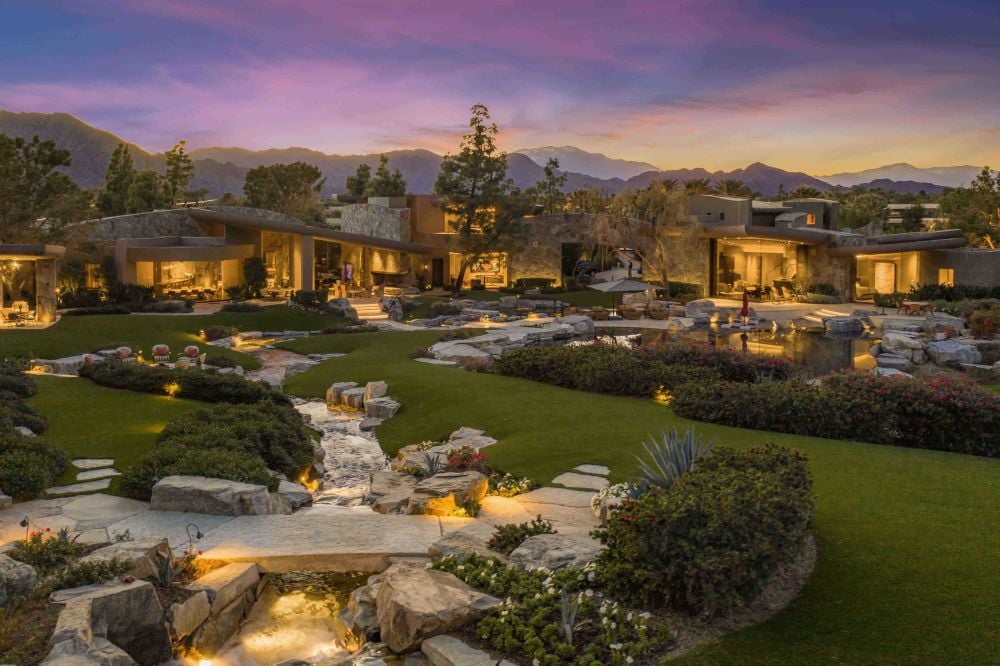




WELCOME TO THE MADISON CLUB
An Exceptional Address. A More Individual Real Estate Decision.
The Madison Club is a private golf and residential community in La Quinta, California, developed by Discovery Land Company around an 18-hole championship course designed by Tom Fazio.
Its identity is shaped by personalized hospitality, distinctive custom architecture, and a desert setting with views of the Santa Rosa and San Jacinto Mountains.
But the property's relationship to that setting is what deserves closer attention.
A custom estate overlooking the fourteenth fairway, a villa near the clubhouse, a privately owned clubhouse suite, and a vacant homesite represent very different purchases, even though they share the same prestigious address.
For some buyers, the priority is a substantial residence with space for family, guests, and entertaining.
Others value privacy, understated architecture, convenient access to the club, or the opportunity to build a home around a particular homesite.
At this level of the market, larger is not automatically better. Nor does an extraordinary asking price establish what a property is worth.
The right Madison purchase begins with understanding the land, the residence, the club, and how all three will work together.
THE COMMUNITY AT A GLANCE
Understanding The Madison Club.
Location
La Quinta, California
Developer
Discovery Land Company
Golf
Private 18-hole Tom Fazio-designed championship course
Residential Options
Custom estates, villas, privately owned clubhouse suites, and custom homesites
Villas
19 residences inspired by the architecture of Addison Mizner
Clubhouse Suites
Five one-bedroom suites of approximately 1,000 square feet
Homesites
Generally approximately 0.5 to 1.5 acres; combined parcels can offer different possibilities
Club Amenities
Golf, dining, fitness, wellness, swimming, tennis, pickleball, and an 18-hole putting course
Membership
Subject to current club requirements, availability, approval, and financial obligations
Property inventory, membership arrangements, and ownership expenses should be confirmed through current documents.
THE MADISON CLUB EXPERIENCE
What Makes The Madison Club Different?
Madison's Tom Fazio course is a central part of the community, but the club's hospitality philosophy is equally important to understanding its appeal.
The clubhouse provides dining, spa and wellness facilities, fitness, swimming, and recreation.
The golf experience incorporates several distinctive refreshment stops throughout the round.
Madison Place, located after the fourth hole, offers refreshments and food during play.
The Dog House provides another stop overlooking the ninth and eighteenth holes, while Madison Market offers refreshments as golfers approach the final portion of the course.
These details are characteristic of Discovery Land Company's approach to private-club hospitality.
For buyers considering Madison, they offer an indication of how the club is intended to be enjoyed, not simply what appears on an amenity list.
But club lifestyle is personal.
A serious golfer may place the greatest value on the course, practice facilities, and time spent playing.
Another household may be more interested in dining, wellness, family activities, and the opportunity to enjoy the desert without organizing every aspect of the day independently.
The club emphasizes personalized service for members and their families. Prospective buyers should explore the specific privileges, guest arrangements, and services available through the membership they are considering.
The question isn't whether Madison offers an exceptional club experience. It's whether that experience aligns with how you'll actually spend your time in La Quinta.
REAL ESTATE INSIDE THE GATES
Four Different Ways to Own at The Madison Club.
One of the most useful distinctions for buyers is understanding that Madison's residential offerings should not all be evaluated using the same criteria.
Custom Estates
Custom estates are central to Madison's residential identity, ranging from sophisticated desert residences to substantially larger properties designed around entertaining, family accommodations, and extensive outdoor living.
Architecture and construction quality vary by property.
A thoughtfully designed estate may offer generous separation between the primary residence and guest accommodations, large garages or vehicle galleries, wellness spaces, and indoor-outdoor entertaining areas.
But additional square footage can also mean greater ongoing maintenance and operating costs.
Buyers should evaluate architectural quality, construction history, permitted improvements, floor-plan functionality, privacy, outdoor orientation, and the practical requirements of maintaining the property.
A remarkable home can still be poorly suited to its next owner.
The Villas
The Madison Club includes 19 villas inspired by the work of architect Addison Mizner, clustered near the heart of the community.
Their location creates a different ownership proposition from a custom estate farther from the clubhouse.
For buyers who intend to use the club frequently, proximity to dining, golf, wellness, and recreational facilities may be particularly appealing.
But not every villa offers the same orientation, privacy, condition, or outdoor experience.
Compare the individual residence, its maintenance obligations, and its relationship to surrounding properties rather than treating all villas as interchangeable.
Clubhouse Suites
One of Madison's least conventional residential offerings is its collection of five privately owned clubhouse suites.
The club describes these one-bedroom accommodations as approximately 1,000 square feet, with concierge service.
A suite may appeal to a buyer whose priority is convenient access to the club rather than maintaining an extensive desert estate.
However, it requires an entirely different ownership analysis.
Buyers should establish the precise ownership interest, occupancy restrictions, included services, recurring expenses, guest arrangements, membership requirements, and resale provisions.
The value of a clubhouse suite should not be judged by comparing its price per square foot with that of a large custom estate.
Custom Homesites
Madison also offers vacant homesites for buyers who want to create a residence around their own architectural and lifestyle priorities.
The club generally describes these parcels as ranging from approximately half an acre to 1.5 acres.
Some offerings combine multiple original homesites.
But purchasing land inside a highly customized residential community involves more than selecting the largest available parcel.
Before buying, confirm design guidelines, permitted building envelopes, setbacks, grading requirements, utility connections, architectural approvals, construction access, and likely development costs.
Consider how a completed residence would occupy the property.
Where will the primary living spaces face? How will the pool and terraces relate to the mountains? What can be seen from neighboring homes? Could the preferred architecture fit within the approved building envelope?
The most valuable homesite is not necessarily the largest. It is the one that can accommodate the residence you want without compromising the qualities that drew you to the property.
THE McLENNAN PERSPECTIVE
Why the Homesite Matters as Much as the Estate.
In Madison, a home's relationship to the landscape can be one of its most significant characteristics.
Mountain views, fairway frontage, privacy, and afternoon exposure all contribute to the ownership experience.
But these advantages require more careful evaluation than a listing photograph usually provides.
Mountain Orientation
Madison's setting creates opportunities for striking views of the Santa Rosa and San Jacinto Mountains.
A south- or southwest-oriented residence may enjoy dramatic mountain framing, but that orientation can also introduce significant afternoon exposure.
The practical question is how the home manages the sun.
Where does shade fall during the afternoon? How comfortable is the principal outdoor entertaining area? What views are visible from the rooms where you'll spend the most time?
A home that photographs beautifully at sunset may feel very different during an afternoon showing.
Fairway Position
Golf-course frontage can provide openness and a desirable visual connection to the landscape.
But looking directly along a fairway differs from looking across one.
The placement of tees, greens, cart paths, landscape screening, and neighboring residences may influence activity, privacy, and sightlines.
An elevated homesite may create an expansive perspective, while another site may offer a more immediate relationship with the course.
Neither is inherently the better choice.
Baffin Avenue & the Fourteenth Fairway
Baffin Avenue offers a useful example of why a street name alone cannot determine the value of a homesite.
The Madison Club has marketed individual and combined parcels along the Tom Fazio course's par-five fourteenth hole.
Among its published offerings are a parcel of approximately 0.59 acre and a combined offering of approximately 1.21 acres.
Both benefit from their relationship to the golf setting, but they represent different opportunities.
The larger combined parcel may provide greater flexibility for the placement of a substantial custom estate.
A smaller parcel may still deliver an exceptional view corridor and a more focused building opportunity.
The important questions concern the actual dimensions, orientation, permitted building area, relationship to neighboring residences, and ability to create the desired indoor-outdoor experience.
The amount of land matters. What that land allows you to create matters more.
Privacy Beyond the Gates
A guarded entrance offers one form of privacy. The physical setting of a residence creates another.
Buyers should study neighboring rooflines, window placement, landscaping, service access, the position of guest accommodations, and visibility from golf-course areas.
A substantial lot does not automatically create complete privacy.
We encourage buyers to understand what can be seen from the property's principal living spaces and what others may be able to see in return.
The Real Cost of Scale
A larger estate may require more extensive landscape maintenance, pool service, property management, security coordination, and care during periods when the home is unoccupied.
Buyers should consider the complete operating requirements alongside the architectural and lifestyle benefits.
At Madison, owning the home and using the home are equally important considerations.
MEMBERSHIP & OWNERSHIP
What Does It Actually Cost to Own at The Madison Club?
A Madison purchase can involve significant financial obligations beyond the real estate asking price.
Buyers should distinguish expenses related to the residence from expenses related to club participation.
Depending on the property and membership arrangement, those may include:
- Homeowners association dues and property-specific assessments
- Club initiation requirements and ongoing membership dues
- Capital contributions or other club obligations, where applicable
- Property taxes and insurance
- Landscaping, pools, utilities, and exterior maintenance
- Property management and seasonal oversight
- Staffing, guest accommodations, and specialized systems for larger estates
A villa, clubhouse suite, vacant homesite, and combined-parcel estate may have different expenses and responsibilities.
Is Club Membership Included with a Property Purchase?
Do not assume that purchasing a Madison residence automatically conveys an approved club membership.
Prospective buyers should verify membership eligibility, application procedures, availability, initiation requirements, ongoing dues, transfer provisions, and the timing of any approval.
These questions should be addressed early, particularly when a purchase depends on specific club privileges.
Publicly circulated membership figures may not reflect the current terms or the arrangement applicable to a particular buyer.
The appropriate documents should come directly from the club.
What About HOA Costs?
HOA expenses may differ by property type and association arrangement.
Obtain the applicable budget, reserve information, governing documents, assessment disclosures, and maintenance responsibilities.
Do not assume that a large custom estate, a villa, and a clubhouse suite carry the same obligations.
Can You Rent a Madison Club Property?
A Madison property should not be purchased on the assumption that short-term vacation rentals are allowed.
La Quinta restricts most new short-term vacation rental permits outside designated exemptions.
The city also provides conditional processes for certain homeshare arrangements and qualifying large-lot properties.
A large parcel does not automatically qualify for a permit.
Madison's governing documents may impose additional restrictions.
If rental flexibility is important, verify eligibility for the specific property address with the City of La Quinta and review the current community documents before making a purchase decision.
THE MADISON CLUB REAL ESTATE MARKET
What Do Madison Club Homes Cost?
Madison's market includes a small number of transactions involving properties that may differ substantially in size, homesite characteristics, construction, and residential category.
That makes broad averages particularly sensitive to the properties included in the calculation.
An exceptionally large custom estate may be marketed at a price many times that of another residence within the same community.
An asking price is also not the same as an achieved sale price.
For buyers and sellers, these distinctions are essential.
Historical MLS Snapshot — July 30, 2026
Closed sales, prior six months | 9 |
|---|---|
Closed price range | $5,875,000–$19,950,000 |
Median closed price | $14,500,000 |
Median closed price per square foot | $1,439 |
Median days on market | 139 |
Median sale-to-list ratio | 92% |
Active listings on July 30 | 4 |
Under contract | 1 |
Source: GPS MLS and CRMLS, subdivision The Madison, La Quinta Area 313, for the six months ending July 30, 2026. Historical figures supplied in the original market report and not independently refreshed. Information deemed reliable but not guaranteed. This is not current inventory.
What Do These Numbers Tell Us?
First, the sample is small.
With nine reported closed sales in six months, the composition of the transactions can meaningfully influence the median price, average market time, and other statistics.
Second, pricing outcomes varied.
The reported median sale-to-list ratio of 92% suggests that the relationship between asking and achieved prices deserves attention, but it does not establish the discount a buyer should expect on an individual property.
Third, marketing time requires context.
A reported median of 139 days reflects that historical group of transactions.
It is not a forecast for a particular listing.
At this level, buyers may be comparing highly individualized estates, weighing the merits of building versus purchasing, and considering properties that have few close substitutes.
For sellers, an ambitious asking price should be supported by the property and relevant market evidence, not simply by the reputation of the community.
For buyers, a high asking price should prompt a thoughtful analysis of the land, architecture, condition, and alternatives.
At The Madison Club, a price-per-square-foot calculation may start the conversation. It should never finish it.
COMPARING PRIVATE CLUBS
The Madison Club, The Hideaway or Tradition?
The Madison Club, The Hideaway, and Tradition Golf Club are all recognized private residential communities in La Quinta.
Each offers a distinctive golf and ownership environment.
The differences are more useful when considered as personal preferences and property-specific choices rather than rankings.
The Madison Club
Madison combines a Tom Fazio-designed course, personalized club hospitality, custom estates, villas, and clubhouse suites.
It may be particularly appealing to buyers seeking a customized residential experience with strong emphasis on the property's setting, the club's services, and the way the residence integrates with private-club life.
The Hideaway
Also originally developed by Discovery Land Company, The Hideaway offers two championship courses designed by Pete Dye and Clive Clark.
It is now member-owned and has a substantial clubhouse and recreational offering.
For golfers who value the option of playing two distinct championship courses within the same club, that difference is worth consideration.
Tradition Golf Club
Tradition is associated with Arnold Palmer, who designed its 18-hole championship course and nine-hole par-three course.
Its historic setting, architectural character, and member-owned club structure distinguish it from the Discovery Land communities.
Buyers who appreciate the history and atmosphere of classic desert golf may find Tradition particularly compelling.
Which Should You Choose?
Both Madison and The Hideaway emphasize family participation and social amenities, so it would be too simplistic to describe one as family-oriented and the other as exclusively private.
The better choice depends on the actual home available, the nature of the club, its membership arrangements, and the experience you want.
A property with the right layout, privacy, orientation, and setting in one community may be a better purchase for you than a more expensive or widely recognized address elsewhere.
FOR MADISON CLUB HOMEOWNERS
Selling a Home at The Madison Club: What Really Drives Value?
An individually designed Madison estate cannot be priced or marketed effectively on reputation alone.
Two properties may occupy similar acreage yet offer different view corridors, architectural quality, privacy, floor plans, and outdoor environments.
A custom residence with extensive guest accommodations, multiple entertaining areas, and substantial service requirements may also appeal to a different buyer than a smaller, more manageable retreat.
A sound selling strategy begins with understanding those differences.
Identify the Right Comparable Properties
Recent sales within Madison provide important context, but not every transaction is directly comparable.
We consider the homesite, building area, architectural quality, construction history, condition, privacy, guest facilities, and the relationship between the home and the golf course.
We also consider whether buyers are comparing the residence against existing homes, available land, or the possibility of constructing something new.
For an unusually large or highly customized estate, a narrow group of close comparable sales may require a more detailed assessment of individual differences.
Position the Land and Architecture Together
Buyers at Madison may care as much about the setting as the interior.
Photography and property presentation should accurately communicate how the home connects to the mountains, fairways, outdoor entertaining spaces, and neighboring landscape.
Architectural history, material quality, construction documentation, significant improvements, and site planning can help distinguish a property when supported by appropriate records.
Understand the Buyer Audience
A substantial custom estate may appeal to someone seeking generous accommodations for family and guests.
Another purchaser may prioritize architectural design, privacy, collection storage, or a smaller residence with convenient club access.
Marketing should explain what makes the home suitable for its likely buyer rather than rely on a generic description of luxury.
Balance Discretion and Market Exposure
Some owners place particular importance on confidentiality.
In those circumstances, a marketing discussion may include the appropriate level of public exposure, qualified buyer outreach, photography permissions, showing procedures, and coordination with community requirements.
The goal is to respect the owner's priorities while establishing a strategy capable of reaching appropriate purchasers.
Any approach must also comply with applicable brokerage and MLS rules.
Price With Discipline
Madison's relatively small transaction volume and wide variation in property characteristics can make valuation complex.
An exceptional residence may justify a premium because of characteristics that cannot easily be recreated.
But extraordinary architecture, extensive square footage, or substantial original construction cost does not automatically establish market value.
The asking strategy should reflect documented property strengths, relevant transactions, current competition, and how prospective purchasers are likely to evaluate the alternatives.
Our objective is not simply to market a home as being at The Madison Club. It is to demonstrate why that particular property is worth considering and to support its market position with credible evidence.
THE MADISON CLUB REAL ESTATE QUESTIONS
Frequently Asked Questions.
Where is The Madison Club?
The Madison Club is located in La Quinta, California, in the Coachella Valley. Its primary entrance is on Meriwether Way, and the community is built around an 18-hole Tom Fazio-designed private golf course.
Who developed The Madison Club?
Discovery Land Company developed The Madison Club as part of its portfolio of private residential and golf communities.
What types of properties can you buy at The Madison Club?
The community includes custom estates, a collection of 19 Mizner-inspired villas, five privately owned clubhouse suites, and custom homesites. Ownership characteristics and availability vary by property type.
How large are Madison Club homesites?
The club generally describes homesites ranging from approximately 0.5 to 1.5 acres. Combined parcels may create larger residential opportunities. The specific buildable area, setbacks, and development requirements should be verified.
What are the clubhouse suites at Madison?
Madison has five privately owned one-bedroom clubhouse suites of approximately 1,000 square feet. They offer concierge service and a different ownership arrangement from custom residential estates. Buyers should confirm occupancy rights, services, expenses, and membership requirements.
Do you have to be a member to buy a Madison Club home?
Buyers should verify the current relationship between property ownership and club membership directly with The Madison Club. Membership approval, eligibility, fees, and applicable purchase requirements should not be assumed.
How much are Madison Club membership fees?
Current initiation requirements, membership dues, and capital obligations should be obtained directly from the club. Publicly circulated amounts may be outdated or may not apply to a particular membership category.
What do Madison Club homes cost?
In the six months ending July 30, 2026, nine reported closed sales ranged from $5.875 million to $19.95 million, with a median of $14.5 million. These historical figures do not represent current availability or the value of an individual property. Estates, villas, suites, and vacant homesites should be evaluated separately.
Can you build a custom home at Madison?
Custom homesites may be available, subject to current inventory. Before purchasing, buyers should review design guidelines, building envelopes, architectural approvals, utility arrangements, and the feasibility and cost of intended construction.
Which Madison Club homesites have the best views?
That depends on the property and the buyer's preferences. Certain sites along Baffin Avenue near the fourteenth fairway offer notable mountain and golf views. But orientation, privacy, adjoining residences, cart-path exposure, and the practical use of outdoor areas must be evaluated for each parcel.
Are short-term rentals allowed at The Madison Club?
Rental eligibility should not be assumed. La Quinta restricts most new short-term vacation rental permits, subject to specified exemptions, and Madison's governing documents may impose additional restrictions. Verify the specific property address and current rules before relying on rental use.
What is the difference between The Madison Club and The Madison on the MLS?
The community is known as The Madison Club, while MLS subdivision data may identify its residential properties under the shorter name The Madison within La Quinta Area 313. Buyers and sellers should use the correct subdivision and property category when reviewing comparable listings and sales.
Is The Madison Club better than The Hideaway?
Neither is universally better. Madison has one Tom Fazio championship course and its own residential and hospitality offerings. The Hideaway has two championship courses designed by Pete Dye and Clive Clark and a different member-owned club structure. The right decision depends on the property, membership terms, recreational preferences, and lifestyle.
What is my Madison Club home worth?
Value depends on the property type, homesite, architecture, condition, privacy, views, improvements, recent comparable sales, and current market competition. An individualized evaluation is more useful than applying the community's median price or a single price-per-square-foot figure.
How should I prepare my Madison Club estate for sale?
Begin with a detailed property review, including architectural and construction documentation, condition, improvements, maintenance history, ownership information, and the home's strongest distinguishing characteristics. Preparation and marketing should be tailored to the likely buyer and the property's current competition.
THE McLENNAN TEAM
The Madison Club, Understood.
For more than 25 years, Laurie McLennan has represented buyers and sellers throughout Greater Palm Springs, advising clients across the desert's established luxury residential markets.
Together, Laurie and Cailin bring complementary professional experience and a thoughtful approach to evaluating distinctive homes and private communities.
Whether you're comparing Madison homesites, considering a custom estate, navigating club membership questions, or preparing to sell, we believe the best advice begins with understanding the property itself.
The architecture, the land, the setting, the financial obligations, and the alternatives available all deserve careful consideration.
An extraordinary address deserves equally thoughtful real estate advice.
The McLennan Team | Desert Sotheby's International Realty
Community information reviewed October 2026. MLS statistics reflect the historical reporting period ending July 30, 2026. Club membership, inventory, fees, ownership terms, and rental eligibility are subject to change and independent verification.