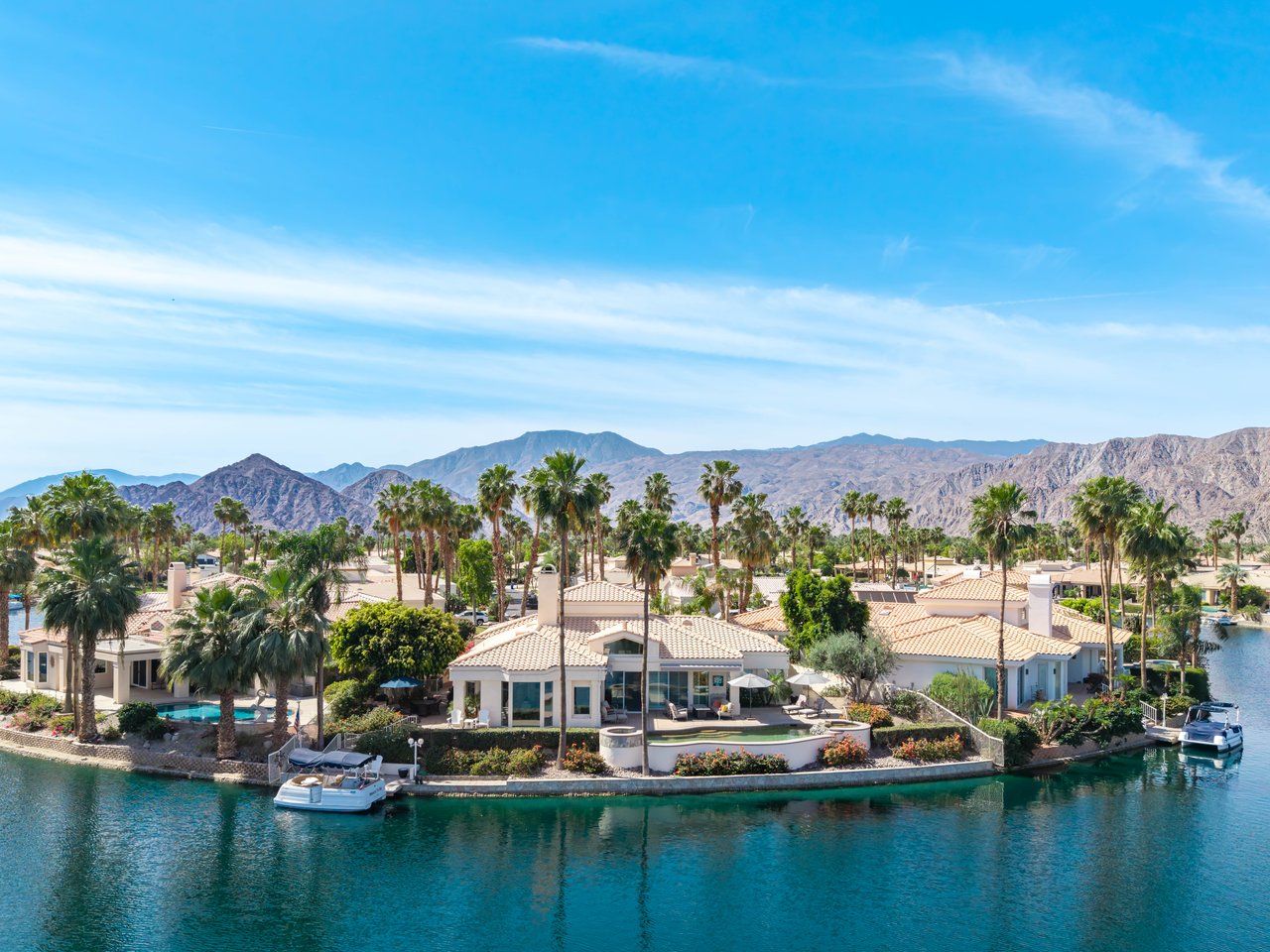
Lake La Quinta Waterfront: Buyer Guide
Lake La Quinta asks a different question from most gated communities in the desert.
There is no golf membership to evaluate and no course frontage to interpret. The community is organized around a man-made lake, so the purchase decision begins with the relationship between the home and the water: how much of it you see, what you see beyond it, when the terrace becomes hot, how private the outdoor space feels and what you are actually permitted to do at the shoreline.
That makes “waterfront” an incomplete description. Two lakefront homes of similar size can deliver very different daily experiences—and deserve very different premiums.
The right way to buy here is to judge the position before the finishes.
Lake La Quinta is a guard-gated, water-oriented community of approximately 288 detached homes arranged around a roughly 25-acre man-made lake. Public community information describes electric boating, kayaking, canoeing and paddle boating, together with a community park, pool, racquet facilities, docks and a launch area. Current rules, eligibility and equipment restrictions should be confirmed through the homeowners association before relying on any particular use.
Homes include both waterfront and interior positions. That distinction matters, but it is only the beginning. Among waterfront homes, value changes with the width and length of the water view, the distance and sightline to homes opposite, rear-yard orientation, shoreline configuration, dock rights and the quality of the mountain corridor.
A well-positioned interior home can be a better purchase than compromised waterfront. A truly strong waterfront position is difficult to replace and deserves to be evaluated separately from the rest of the market.
Community type: Guard-gated, non-golf residential community
Residential character: Detached homes in waterfront and interior positions
Central amenity: Approximately 25-acre man-made lake
Published community size: Approximately 288 homes
Published recreation: Electric boating and non-motorized water activities, subject to current rules
Shared amenities: Park, community pool, tennis, pickleball, picnic and launch facilities, subject to verification
Membership: No private golf-club membership attached to the purchase
The purchase variable that matters most: The quality of the property’s position relative to the water
Community specifications, association coverage and water-use rules can change. Confirm them in the current governing documents and written association disclosures.
Many Coachella Valley buyers want a guarded gate, attractive common areas and a sense of arrival, but do not want their home choice or carrying costs organized around a private club.
Lake La Quinta gives that buyer a distinct alternative. Water—not golf—is the visual and recreational center of the community. The result can feel more residential, more informal and less dependent on a club calendar.
Its location near everyday shopping, dining and major La Quinta routes also changes the use case. This is not simply a secluded resort address. For the right buyer, it can function as a seasonal retreat, a full-time residence or a lock-and-leave base without requiring golf to justify the purchase.
That is the strategic appeal. The buying discipline, however, is entirely specific to waterfront property.
Interiors, systems, landscaping and even some dock improvements may be changed. The following usually cannot:
At Lake La Quinta, the scarce asset is not merely frontage. It is a broad water outlook with useful privacy and an orientation that allows the outdoor space to work through more of the season.
When those qualities coincide, the premium can be defensible. When a listing offers only the word “waterfront,” it may not be.
We evaluate five variables before comparing finishes or price per square foot.
How much water is visible from the rooms and outdoor spaces that matter?
A broad basin view behaves differently from a narrow channel view. A buyer should stand at seated eye level in the living room, primary bedroom and main terrace—not only at the best photographic corner of the yard.
The useful question is not “Can I see the lake?” It is “How much water remains in the view during ordinary life?”
What sits across the water, and how directly does it face you?
Water creates visual openness, but not necessarily privacy. On narrower stretches, opposing terraces, rear windows and docks can have a direct relationship. The experience is reciprocal: if you can clearly observe the home opposite, its occupants can generally observe you.
Distance, angle, landscaping and the location of outdoor living areas all matter. A long diagonal sightline can feel far more private than a straight view across a shorter channel.
When does the outdoor space receive direct sun, and how does the water reflect it?
West-facing water can be beautiful in the evening, but reflected afternoon light may increase glare and heat. North- and east-oriented rear spaces often remain comfortable later into the warm season, although shade, architecture and surrounding landscape can modify the result.
Test the terrace at the time of day you expect to use it. A sunset photograph does not tell you whether the seating area is comfortable at four o’clock.
How much usable space sits between the home and water?
Some lots provide a generous sequence of covered terrace, pool, lawn or hardscape and shoreline. Others compress these elements. That affects privacy, entertaining, child or pet considerations, maintenance and the visual prominence of any dock.
Also inspect how the water’s edge is constructed and who is responsible for each component. A beautiful shoreline is still part of an ownership system.
Can the waterfront be used in the way the buyer imagines?
The existence of a dock does not establish that it is approved, that it conveys without qualification or that every type of watercraft is permitted. Before assigning value, confirm current association rules, registration requirements, dimensions, storage rules, guest use and responsibility for repair or replacement.
A waterfront feature is an amenity only when its intended use is allowed.
These typically deliver the strongest sense of openness and may create longer sightlines toward mountains or landscaped edges. They can also receive more reflected sun and may feel more exposed to activity on the lake.
A channel can feel intimate and protected, particularly when the view runs diagonally along the water. A narrow, face-to-face channel can also reduce privacy. Width alone does not decide the issue; the angle of the home and the location of opposing outdoor areas can matter more.
Where water changes direction, a property may gain a longer diagonal view, fewer direct sightlines or a more layered outlook. It may also experience more passing boats or a visually busier shoreline. These positions should be judged individually.
Interior does not mean inferior. A well-oriented interior property may offer greater privacy, a larger or more usable yard, a stronger mountain view and a materially lower acquisition cost.
For a buyer who likes the community but will not use a dock frequently, the interior option can be the more rational purchase. The right comparison is not waterfront versus no waterfront in the abstract. It is the best daily experience available at each price.
A premium becomes more defensible when several durable attributes occur together:
It becomes less defensible when the label “waterfront” masks a narrow view, direct rear-to-rear exposure, difficult afternoon heat, limited usable yard or uncertain dock status.
This is why a single community-wide price-per-square-foot figure can mislead. It blends properties whose land positions are not equivalent.
Public community descriptions reference electric party boats and non-motorized activities such as kayaking, canoeing and paddle boating. That is useful context, but it is not a substitute for the current rules.
Do not let personal property and real property blur together. If a boat, lift, dock equipment or furnishings are material to the purchase, identify them precisely in the offer and confirm the association’s requirements.
The lake is the community’s defining shared asset. It is also infrastructure.
A buyer should review not only the association’s general budget and reserves, but the documents that explain how the lake is operated and maintained. Ask about water quality, circulation, mechanical equipment, shoreline work, dredging or sediment management, landscape interfaces and long-term capital planning.
A high-quality shared asset should be underwritten like one. The goal is not to find an association with no costs; it is to understand whether responsibilities and reserves are clear.
Lake La Quinta’s homes were developed within a relatively defined era, but condition now varies substantially. Some remain close to their original specification. Others have cosmetic updates, and some have been more comprehensively rebuilt.
A beautifully finished interior can justify a premium within the interior market. A thoroughly updated waterfront home can command more when the renovation improves the connection to the lake. But an expensive remodel cannot widen a channel, change the opposing sightline or rotate the rear yard away from afternoon sun.
Look beyond photographs for:
The strongest renovations respond to the site. Generic finishes do not correct a weak one.
Lake La Quinta can work well for seasonal ownership, but waterfront introduces a few additional responsibilities.
Before buying, identify who will monitor:
Then distinguish association work from owner work. “The HOA takes care of the lake” may be true at a broad level while leaving the dock, landscape edge or other improvements to the homeowner.
A good lock-and-leave property is not simply gated. Its responsibilities are documented and manageable from a distance.
The market table should separate waterfront and interior homes. If the sample permits, it should also identify meaningful position differences within the waterfront set rather than presenting one blended median.
Recommended reporting structure:
For every snapshot, state the MLS source, retrieval date, reporting period, map or community boundary, sample size and exclusions. Do not infer a precise waterfront premium from a small or compositionally different sample.
For a useful analysis, do not automatically blend:
The purpose of the snapshot is decision support, not a headline number.
Lake La Quinta may suit a buyer who wants:
It may be less appropriate for a buyer who wants:
The important question is not whether lake living sounds appealing. It is whether the particular property delivers the version of it you intend to use.
Choose Lake La Quinta when the water outlook, residential setting and freedom from a required club relationship are central to the decision.
Choose a private golf community when course access, practice facilities, dining and a built-in social environment are part of the value proposition.
Neither is inherently the more luxurious choice. Luxury is the fit between the property and the life a buyer intends to lead.
For golf-centered alternatives, compare our guides to Rancho La Quinta Country Club, PGA WEST and other La Quinta communities. For another form of non-golf desert living, compare communities based on the same durable variables: position, privacy, orientation, association responsibility and resale audience.
Our role is not to identify which listing has the longest amenity list. It is to determine which advantages survive the next renovation cycle and which claims are merely descriptive.
For a Lake La Quinta property, our review asks:
That is the difference between buying “on the lake” and buying the right waterfront property.
No. The community includes waterfront and interior homes. Interior owners may benefit from shared community amenities, subject to current rules, without paying the acquisition premium associated with direct frontage.
No. View width, opposing privacy, orientation, lot configuration, dock status and renovation quality all affect value. “Waterfront” should be the start of the analysis, not the conclusion.
Public community descriptions reference electric party boats and non-motorized craft, but the governing rules control. Confirm permitted types, dimensions, motors, registration, storage and guest use directly with the association before an offer.
Do not assume it does. Confirm ownership, approval, maintenance responsibility and any transfer or registration requirements. Identify included boats and equipment separately in the purchase documents.
Not automatically. Those exposures can reduce late-day heat, but architecture, shade, water geometry and the desired view also matter. Evaluate comfort at the time of day the outdoor space will actually be used.
Yes. An interior property with privacy, favorable orientation, a useful yard and a mountain view may deliver a better daily experience at a lower price than compromised frontage.
No. Its defining shared asset is the lake rather than a private golf club. That makes it relevant to buyers who want gated desert living without organizing the purchase around golf membership.
Clarify responsibility for the dock, shoreline edge, landscaping, pool, exterior systems and property checks. Review association rules, reserves and recent meeting minutes, and establish a local care plan.
A changing market. A more discerning buyer. A smarter approach to selling in the desert.
The Location Edit

The Real Estate Edit
The Property Edit
Summer brings far less to choose from and considerably more leverage.
Two private clubs in the same small city, about three miles apart, and they could hardly be less alike.

This distinction reflects a consistent commitment to excellence, market expertise.
Lake La Quinta asks a different question from most gated communities in the desert.
A historic club. A patchwork of residential structures. No single version of ownership.
You may be a season away. You may be deciding between two communities. You may be wondering whether to sell now or wait. Call us with the unfinished version. That is the conversation we are best at.